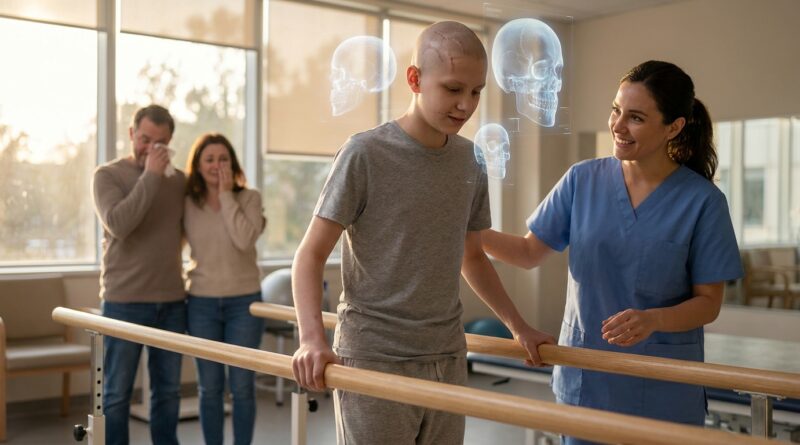
The Teen Who Got a New Skull: Inside Doctors’ ‘We’ve Never Seen a Recovery Like This’ 3D‑Printed Miracle
It is hard not to feel worn down by the news. So many medical stories end with words no family ever wants to hear. That is why this real life miracle story about a teen who survives a fall and goes on to have 3D printed skull surgery hits so deeply. A three story fall usually brings fear, long odds, and a future full of questions. In this case, doctors were staring at devastating injuries, including a badly shattered skull, and his loved ones were left hoping for any sign at all that he might come back to them. What happened next sounds almost too dramatic to be true, but it was not magic in the movie sense. It was skilled trauma care, careful planning, cutting edge 3D printing, and the kind of stubborn family love that refuses to let go. And somehow, against expectations, this teenager did not just survive. He recovered in a way even his doctors said they had never seen before.
⚡ In a Hurry? Key Takeaways
- This teen’s survival after a three story fall and custom 3D printed skull surgery shows how modern medicine can turn terrible odds into real recovery.
- If your family is facing a major diagnosis or trauma, ask care teams to explain reconstruction options, rehab plans, and what newer tools or specialist centers may be available.
- Stories like this are hopeful, but they also remind us that recovery takes time, expert follow-up, and strong support at home.
What actually happened
The broad outline is startling enough on its own. A teenager suffered a catastrophic three story fall. The kind of accident that makes everyone around him fear the worst. He survived the initial trauma, but survival was only the first mountain to climb.
His skull had been severely damaged. That means doctors were not only trying to protect his brain and keep him alive in the moment, they also had to think ahead about how to rebuild part of his head safely and accurately.
This is where the story moves from tragedy into something that feels almost unbelievable. Instead of using a one size fits all approach, doctors created a custom 3D printed skull implant designed for his exact anatomy. In plain English, they built a replacement piece made to fit him, not just a generic patient.
Then came the part that left seasoned doctors stunned. He recovered. Not just a little. Not just enough to be called lucky. He recovered so well that the people caring for him reportedly described it in terms that families dream about hearing. They had never seen a recovery like this.
Why a 3D printed skull matters so much
To a non medical person, “3D printed skull implant” can sound futuristic, even a little scary. It helps to think of it like a highly precise custom part for the body.
It starts with imaging
Doctors use detailed scans to understand the exact shape and size of the missing or damaged area. That imaging becomes the blueprint.
Then the implant is designed to fit the patient
Instead of forcing the body to adapt to a rough substitute, the implant is made to match the patient’s unique skull structure as closely as possible.
That can improve both protection and appearance
The skull is not just there to shape the head. It protects the brain. A well fitted implant can help restore that protection while also improving comfort and symmetry.
For families, that matters on two levels. There is the medical level, obviously. But there is also the human level. A custom reconstruction can help a patient feel more like themselves again after a life changing injury.
Why doctors were so amazed by the recovery
When doctors say they have never seen a recovery like this, that usually means several things came together at once.
The injury was severe
A three story fall can cause multiple injuries at the same time. Head trauma alone can change a life forever. Add swelling, surgery risk, infection risk, and rehab, and the road gets even steeper.
The brain does not follow a neat script
Even with great care, no doctor can promise exactly how someone will recover from a major head injury. Some patients improve slowly. Some hit plateaus. Some need years of therapy.
His outcome beat expectations
That is the heart of this story. Not simply that he lived, but that he came back in a fuller way than many people thought possible. That kind of outcome sticks with medical teams because they know how fragile these cases can be.
The part people sometimes miss: miracles often look like teamwork
When people hear “miracle,” they often picture something instant. A flash. A sudden turn. Real life usually looks different.
In stories like this, the miracle is often a mix of things. Fast emergency response. Skilled surgeons. Intensive care. Imaging specialists. Engineers or medical device teams who can make the implant. Nurses who watch every little change. Therapists who help the patient relearn strength and balance. Parents and loved ones who keep showing up when the days are long and the progress is uneven.
That does not make it less miraculous. If anything, it makes it more moving. Because it reminds us that hope can arrive through human hands, not just dramatic moments.
What families can learn from this story
Most readers will never need skull reconstruction surgery, thankfully. But many will face a frightening diagnosis, an accident, or a moment when medicine suddenly becomes part of daily life. This story has real value there.
Ask what the full plan looks like
In a crisis, families often hear the first emergency update and stop there emotionally. Try to ask about the next steps too. What happens after stabilization? Is reconstruction possible? What does rehab look like? Are there specialists who should be brought in?
Specialized centers can make a huge difference
Not every hospital offers the same level of trauma care or reconstructive technology. In complex cases, it is reasonable to ask whether transfer to a major center or consult with a specialist is appropriate.
Recovery is rarely a straight line
One of the hardest things for families is waiting. Some days look promising. Others feel like a setback. That does not always mean things are going badly. Big recoveries are often messy and slow before they become clear in hindsight.
Hope and realism can live in the same room
You do not have to choose between being honest about risk and believing things can still improve. Good doctors do both. Good families do too.
How 3D printing is quietly changing medicine
This story stands out because it is dramatic, but the technology behind it is part of a larger shift that is already happening in hospitals.
3D printing is being used to create patient specific implants, surgical guides, models for planning difficult procedures, and devices tailored to unusual anatomy. For regular people, the simplest way to understand the value is this: more personalization can mean a better fit, better planning, and sometimes better outcomes.
That does not mean every problem has a 3D printed answer. It does mean medicine is getting better at treating individual bodies instead of relying only on broad averages.
Why this story lands so hard right now
People are hungry for proof that not every terrible headline ends the same way. We scroll past war, outrage, sickness, and loss all day. After a while, it can start to feel like bad news is the only kind left.
That is why a real life miracle story about a teen surviving a fall and 3D printed skull surgery spreads so quickly. It gives people something they do not get enough of. Relief. Awe. A reason to believe that medicine still has room for wonder.
It also helps families already living through scary medical chapters. They know better than anyone that hope can feel fragile. Seeing one teenager come back from the edge does not erase anyone else’s pain, but it can make tomorrow feel a little less impossible.
At a Glance: Comparison
| Feature/Aspect | Details | Verdict |
|---|---|---|
| Initial prognosis | Severe trauma from a three story fall, with major concern about survival and long term damage. | Extremely serious, low expectations at the start. |
| Treatment approach | Advanced trauma care followed by a custom 3D printed skull implant built to match the teen’s anatomy. | A powerful example of personalized modern medicine. |
| Outcome | Doctors reportedly saw a level of recovery they described as unlike anything they had seen before. | A rare and deeply hopeful result. |
Conclusion
Today’s feeds are full of conflict, outrage, and medical horror stories that end in grief. That is exactly why this teenager’s survival matters so much. A teen survives a three story fall, then has his shattered skull rebuilt with a custom 3D printed implant, and somehow makes it back toward a normal life. That is not just a gripping headline. It is proof that hope still has a place in modern medicine. When you look closely at what happened, the lesson is even stronger. Doctors, technology, prayer, persistence, and love all had a part in pulling him through. For families facing their own diagnoses, that matters. It says the future is not always written at the worst moment. It says medicine is still full of surprise. And it says tomorrow’s solutions are not just science fiction. In some hospitals, they are already saving lives right now.