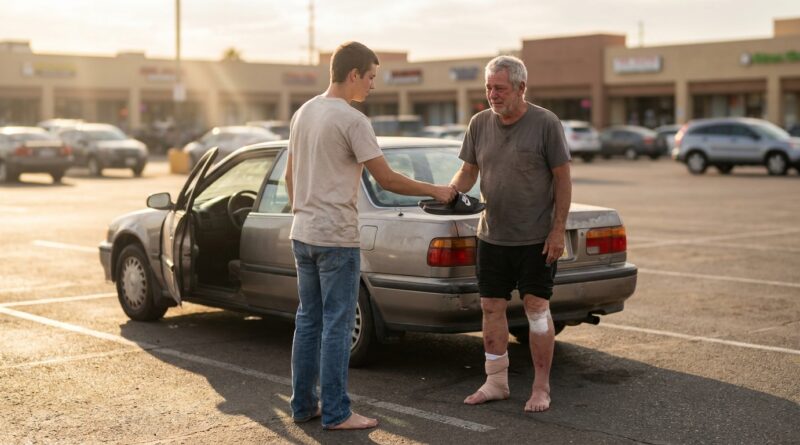
The Teen Who Gave Away His Shoes: Inside a ‘God Told Me to Turn Around’ Parking Lot Miracle
It is hard not to feel worn down right now. So much of what we see every day is loud, angry, polished, and somehow still empty. After a while, you start asking a quiet question. Does anybody still stop for anyone? And if they do, is it ever more than a nice little moment? That is why this real life miracle kindness story about a teen who gave his shoes to a stranger in a parking lot is landing so deeply with people today. It did not happen on a stage. It did not come with a sponsor, a camera crew, or a speech. It was just an ordinary young man, an inner nudge he could have ignored, and another person in need standing right there in front of him. Sometimes the stories that stay with us are not the biggest ones. They are the ones that prove compassion is still alive, still practical, and still capable of changing somebody’s whole day.
⚡ In a Hurry? Key Takeaways
- This story matters because a teen followed a strong inner prompt, turned around, and gave his own shoes to a stranger who needed them.
- If you feel nudged to help, pause and look again. Small acts like buying food, offering shoes, or simply asking a kind question can mean more than you think.
- Kindness still needs wisdom. Help in ways that are safe, direct, and respectful, especially when approaching strangers in public.
What happened in the parking lot
The heart of the story is simple, and that is part of why it feels so powerful.
A teen was leaving a parking lot when he felt a strong sense that he needed to turn around. Not later. Not when it was more convenient. Right then. He listened to that inner pull, went back, and ended up giving his shoes to a stranger who needed them.
That is it. No grand setup. No complicated chain of events. Just one person noticing, responding, and parting with something he was wearing because somebody else needed it more.
For some people, that kind of moment sounds like God speaking. For others, it feels like grace, conscience, compassion, or a gut-level moral clarity. Whatever language you use, the result was the same. A person in need was seen, and a teen chose inconvenience over comfort.
Why this feels bigger than just a pair of shoes
Shoes are practical. They protect your feet, help you move, and let you get where you need to go. Giving away your own pair is not symbolic in the abstract. It costs something.
That is what makes this story hit home.
The teen did not give away an extra item from a closet. He gave what he had on him. In everyday life, that is often the line between “that was nice” and “that was sacrificial.” Real compassion usually interrupts plans, creates awkwardness, or asks us to give up comfort we were planning to keep.
And for the person receiving those shoes, the gift was probably about more than footwear. It said, “I see you. You are not invisible. Your need matters enough for me to stop.” That kind of dignity can stay with a person long after the moment ends.
The part people recognize immediately
That inner prompt
Most of us know the feeling, even if we do not always act on it.
You are heading home and suddenly feel like you should go back. You notice someone sitting alone and think you should ask if they are okay. You are about to scroll past a message and instead feel like you should call. Often, we explain those moments away. We are busy. We second-guess ourselves. We do not want to seem weird.
This teen did the rare thing. He trusted the nudge enough to act on it.
That is why people are calling this a miracle. Not because the laws of physics bent in a parking lot, but because human beings so often miss these moments, and this time someone did not.
Why stories like this matter right now
People are tired of headlines that spike emotion and leave nothing useful behind. A lot of news gives you outrage, fear, or spectacle. Very little gives you a next step.
This story does.
It says ordinary people still have the power to change a moment, a day, or even a life. You do not need money, status, or a huge audience. You need attention. You need courage. And sometimes you need to be willing to look a little foolish for thirty seconds in order to do the right thing.
That is refreshingly concrete.
How it probably felt on both sides
For the teen
He likely had a split second where he wondered if he should ignore the feeling and keep going. Most of us would. Then came the decision to turn around, approach a stranger, and offer something personal.
That takes nerve.
It also takes humility. A lot of kind acts die in the gap between feeling prompted and not wanting to make things awkward. He crossed that gap.
For the stranger
Being in need in public can feel exposing. Whether the need is obvious or quiet, it often carries shame. So when someone helps gently and directly, it can land as more than relief. It can feel like being remembered.
Not rescued. Remembered.
That difference matters. The best acts of kindness do not make a person feel small. They remind them they still matter.
How to recognize your own moment to help
You do not have to wait for a dramatic scene in a parking lot. These moments show up in plain clothes.
1. Notice what sticks with you
If a person or situation keeps tugging at your attention, do not dismiss that too quickly. Sometimes the strongest clue is simply that you cannot quite move on.
2. Start with one small question
You do not have to solve someone’s whole life. You can ask, “Are you okay?” or “Can I help with something practical?” That opens the door without assuming too much.
3. Offer something concrete
Kindness works best when it is usable. Food. Water. Socks. Shoes. A ride if appropriate. A phone call. A paid bill. Specific help is often better than vague sympathy.
4. Keep it respectful
Help should protect dignity, not put someone on display. If you can offer support quietly, that is often the better path.
5. Use common sense
You can be compassionate and still be wise. Stay in public places, trust your instincts, and involve staff or local services when needed.
Faith, grace, and the language people use for moments like this
Some readers will hear this story and say, “That was God.” Others will say, “That was human goodness at its best.” Honestly, both responses are trying to describe the same mystery from different angles.
Something interrupted routine. Something moved a person toward generosity. Something good happened because he listened.
You do not have to force a label onto that if labels are not your thing. But you also do not have to talk yourself out of the possibility that God still nudges people in ordinary places.
Parking lots count too.
What this real life miracle kindness story teaches us
The lesson is not “go give away your shoes no matter what.” The lesson is deeper and more useful.
Stay interruptible.
That is the hard part for most of us. We build lives around efficiency. We plan our routes, guard our time, and keep our eyes forward. But compassion usually enters from the side. It asks us to pause, circle back, and pay attention to the human being we almost missed.
This teen did exactly that. He turned around.
That may be the most important detail in the whole story.
At a Glance: Comparison
| Feature/Aspect | Details | Verdict |
|---|---|---|
| What made the story powerful | A teen acted on an inner prompt and gave his own shoes to a stranger in need, in an ordinary parking lot. | Simple, credible, and deeply human. |
| Main takeaway for readers | Small, practical acts of compassion can become life-giving moments when we stop and respond. | Immediately useful in daily life. |
| Best way to apply it | Pay attention to quiet nudges, offer concrete help, and act with both kindness and wisdom. | A realistic model for everyday compassion. |
Conclusion
This is why the story is spreading. Not because it is flashy, but because it is believable. Right now feeds are full of arguments, disasters and drama, and people are exhausted by big flashy headlines that do not give them anything practical to hold on to. This story is the opposite. It is a real, grounded act of compassion in the most ordinary place imaginable, between two strangers who will probably never go viral again. And that is exactly why it matters. It gives us a concrete picture of what it looks like to notice a quiet inner prompt, trust that it might be God or grace at work, and take one small risk for someone else’s good. You do not need a platform, a title, or a perfect life to be part of something extraordinary today. You just need to be willing to stop, see the person in front of you, and respond.