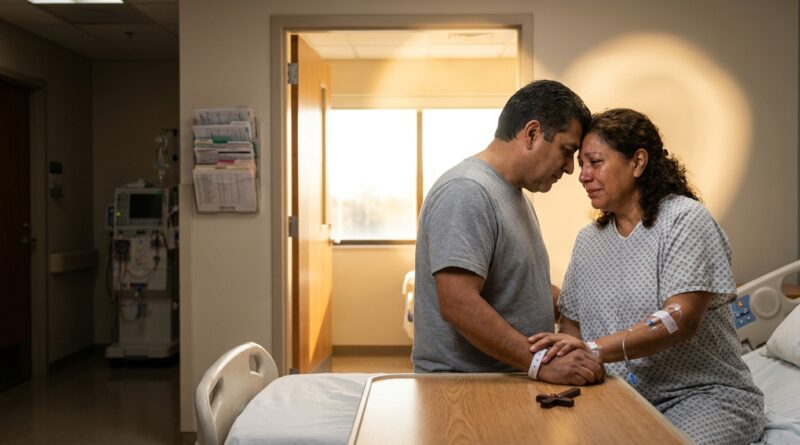
The Husband Who Became Her Kidney Donor: Inside a ‘Marriage On the Brink’ Miracle That Rebuilt a Family
Some pain does not explode into your life. It drips. Day after day. A diagnosis. A machine. Bills. Tired eyes. Sharp words at home. Then one morning you realize the illness is not the only thing draining the life out of the house. For many couples, that is the harder miracle to ask for. Not just, “Lord, heal this body,” but, “Lord, please save what is left of us.” That is why this real life miracle kidney transplant husband donates kidney to wife story hits so deeply. It is not a neat tale about instant answers. It is about a woman facing the brutal routine of dialysis while her marriage sat on the edge of collapse. It is about a husband who seemed far away in spirit, then stepped forward in the most costly way possible. And it is about a family rebuilt slowly, painfully, and beautifully, in a way that reminds us that God still works in homes that look too worn out to fix.
⚡ In a Hurry? Key Takeaways
- This testimony shows that a miracle can heal both a failing body and a failing marriage, even after a long season of silence.
- If your family is in a slow crisis, keep praying, get medical and emotional support, and do not assume delay means God is absent.
- Kidney donation is a serious medical process, not a romantic gesture alone. Testing, counseling, and follow-up care matter for both donor and recipient.
When the Real Crisis Is Bigger Than the Diagnosis
Chronic illness has a way of shrinking life. Plans get smaller. Energy gets smaller. Hope can get smaller too.
In this story, the wife was not just sick. She was being worn down by kidney failure and the hard routine that comes with it. Dialysis is not a small interruption. It can take over the rhythm of a household. It touches work, sleep, parenting, meals, money, and mood.
And often, it exposes cracks that were already there.
That is what makes this testimony so gripping. The marriage was not strong and shiny while the medical storm hit. It was hurting. Trust was thin. The relationship was frayed. From the outside, it looked like too much had gone wrong for one family to come back from it.
A Marriage on the Brink
There is a kind of loneliness that comes from being sick around other people. You are not technically alone. But you still feel unseen.
Many readers will understand that. You can be sitting in a waiting room, lying in a hospital bed, or coming home from treatment, yet still feel emotionally abandoned. That kind of pain cuts deep because it mixes physical weakness with heartache.
In this case, the wife was not only fighting for her health. She was also carrying the grief of a marriage that felt shaky at best. That is why the phrase “marriage on the brink” does not feel dramatic here. It feels honest.
Sometimes families do not fall apart in one giant moment. They erode. One missed conversation at a time. One disappointment at a time. One exhausted night at a time.
The Turning Point Nobody Could Manufacture
Then came the moment that changed the story. Her husband chose to be tested as a kidney donor.
That matters on the medical side, of course. Living donation can shorten waiting time and, in many cases, offer strong outcomes for the recipient. But in a family story like this, it means something more. It is a physical act of sacrifice that says, “I am still here. I have not stopped fighting for you.”
That does not erase every old wound in a second. Real life is not that tidy. But it can break through years of numbness. It can start a different conversation. It can reopen a door both people thought was shut.
Why this felt like more than good timing
People use the word miracle in different ways. Some reserve it for the medically impossible. Others use it for any answer to prayer. This story lands in a place many hurting families will recognize.
The miracle was not only that a transplant became possible. The miracle was that love, responsibility, and covenant seemed to wake up again in a place where they had gone quiet.
That is a different kind of healing. But it is real.
The Medical Reality Behind the Miracle
It is worth saying clearly that kidney donation is not simple. A husband donating a kidney to his wife is moving and powerful, but it also involves serious screening and long-term care.
What usually has to happen first
Living donors are generally checked carefully for blood type compatibility, tissue matching, kidney function, heart health, infection risk, and overall fitness for surgery. They also speak with medical teams and often social workers or counselors to make sure the choice is informed and voluntary.
For the recipient, the transplant process includes testing, surgical planning, anti-rejection medication, and close follow-up after surgery.
So when people talk about a real life miracle kidney transplant husband donates kidney to wife, it is helpful to remember this was not careless emotion. It was love moving through a real medical process, with risk, courage, and commitment attached.
What This Family’s Story Says to People in Long Battles
A lot of miracle stories center on one dramatic moment. This one speaks to a different audience.
It speaks to the spouse who is tired of pretending things are fine.
It speaks to the caregiver who feels guilty for being exhausted.
It speaks to the sick parent who wonders whether their home will survive the strain.
And it speaks to the Christian who keeps praying but feels like the ceiling is getting every prayer back first.
The lesson here is not that every transplant request will end the same way. It is not that every damaged marriage will be restored in one dramatic act. The lesson is that God’s work in a family can be slow, layered, and surprising. He may start in one place and heal another too.
Miracles Are Sometimes Quiet Before They Are Visible
One of the hardest parts of suffering is the delay. People can handle pain better when they know exactly when it will end. What breaks us down is not always the crisis itself. It is the waiting.
This testimony gives readers something solid in that waiting. It suggests that silence is not always absence. Delay is not always denial. Some rebuilding happens out of sight long before anybody can point to the finished result.
That idea matters for marriages under pressure. It matters for parents trying to keep a peaceful home while treatment schedules rule the week. And it matters for believers who wonder whether they are foolish for still hoping.
What Readers Can Take From It Right Now
You may not be facing kidney failure. But you may be facing your own version of a long hallway with no obvious exit.
If your home is under strain, start here
First, tell the truth about how serious things are. Quiet suffering can become invisible suffering.
Second, separate spiritual hope from denial. Pray boldly, yes. But also use the help available. Doctors. Counselors. pastors. Trusted family. Real support is not lack of faith.
Third, watch for small signs of softening. Not every breakthrough starts big. Sometimes it starts with one honest conversation, one appointment kept, one apology, one brave decision.
Finally, keep your definition of miracle wide enough to notice what God may be doing. Sometimes He heals in an instant. Sometimes He rebuilds through process, repentance, treatment, patience, and sacrificial love.
Why This Story Stays With You
Stories like this stay with people because they meet us where many of us actually live. Not in headline-sized disasters, but in private battles that stretch over months and years.
A husband donating a kidney to his wife is dramatic, yes. But what really marks the heart is what it represented. It became a sign that what looked dead in the family was not beyond God’s reach.
And for readers who feel stuck in a house full of stress, disappointment, and unanswered prayers, that matters deeply. It gives language to hope again without pretending the road is easy.
At a Glance: Comparison
| Feature/Aspect | Details | Verdict |
|---|---|---|
| Physical healing | The wife moved from the draining cycle of dialysis toward new life through a kidney transplant from her husband. | A clear, life-changing medical breakthrough. |
| Marriage restoration | The donation symbolized sacrifice, renewed commitment, and a reopened path toward trust and covenant. | Just as powerful as the transplant itself. |
| Reader takeaway | Miracles are not always instant. They can unfold through treatment, prayer, patience, and costly love. | Deep encouragement for long-haul battles. |
Conclusion
Right now a lot of our readers are not facing a sudden car crash or lightning strike. They are facing the slow grind of chronic illness, broken trust, and a marriage that feels one hard conversation away from ending. This testimony speaks straight into that kind of discouragement. It shows a God who does more than heal a body. He stitches a home back together through a process that can look, for a long time, like silence and delay. A woman went from being carried into dialysis, abandoned in spirit, to walking out with a new kidney and a renewed covenant. That gives the rest of us language for our own prayers when nothing seems to move. It also widens our idea of miracle. Not just split-second rescue, but deep restoration. And in a year full of quiet, private battles, that kind of hope is not small. It is the kind people live on.