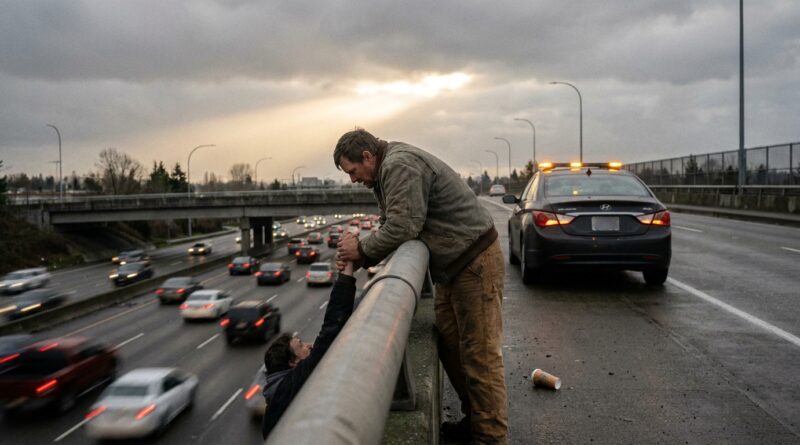
The Stranger Who Stopped on the Bridge: Inside a ‘He Wasn’t Supposed To Be There’ Highway Miracle
Some days it really does feel like the world has gone numb. You read one brutal headline after another, sit in traffic with strangers sealed off in their own bubbles, and start to wonder whether anyone still notices when another human being is in real trouble. That is why this real life highway bridge rescue miracle story hits so hard. It was not flashy. It was not staged. It was one ordinary commuter, already running late, who took an exit he was not even supposed to be on and spotted a man standing on the wrong side of a bridge barrier. Instead of driving past and telling himself someone else would handle it, he stopped. He talked. He stayed. And in those few minutes, on a noisy stretch of highway where people usually keep moving, one stranger interrupted another stranger’s worst moment and helped keep him alive.
⚡ In a Hurry? Key Takeaways
- This real life highway bridge rescue miracle story matters because one ordinary driver noticed danger, stopped, and helped save a life.
- If you ever see someone in distress near a road or bridge, call 911 first, keep a safe distance, speak calmly, and stay present until trained help arrives.
- The biggest lesson is simple. Attention saves lives. You do not have to be a hero in a movie to make a real difference.
Why this story feels bigger than one commute
There is a reason stories like this spread so quickly. People are hungry for proof that kindness still shows up unannounced. Not polished kindness. Not social media kindness. Real kindness that costs time, comfort, and maybe a little courage.
That is what makes this bridge rescue feel like a small miracle. The man who stopped was not a first responder on duty. He was not out looking for a dramatic moment. By all accounts, he was just trying to get where he needed to go. Then he noticed something was wrong, and he trusted that instinct instead of talking himself out of it.
That split-second choice matters more than we like to admit. A lot of life turns on whether somebody slows down long enough to really see what is happening.
What reportedly happened on the bridge
The outline is painfully familiar and deeply human. A commuter took an unusual exit, ended up near a highway bridge, and spotted a man in clear distress. The stranger was somewhere he should not have been, near or beyond the safety barrier, which is often the first sign that this is not just a breakdown or a stalled car situation.
The driver pulled over and made the choice many people fear making. He got involved.
He did not rush in recklessly. He did not turn the moment into a performance. He did the useful things. He called for help. He spoke to the man. He stayed present. He kept the person talking until emergency crews could arrive and take over.
That is often what rescue looks like in real life. Not perfect words. Not cinematic speeches. Just calm, patient presence at exactly the right time.
Why “he wasn’t supposed to be there” is the whole point
That phrase sticks with people because it captures how fragile some life-saving moments are. The rescuer was not supposed to be on that route. He was not supposed to be delayed. He was not supposed to notice at that exact second.
And yet there he was.
You can call that luck, timing, providence, instinct, or all of the above. What matters is that an accidental detour became somebody else’s second chance. That is why this real life highway bridge rescue miracle story lands so deeply. It reminds us that our ordinary days cross other people’s emergency moments all the time, and we usually do not know it.
What this teaches the rest of us
1. Noticing is a real skill
Most people are tired, distracted, and mentally half somewhere else. We miss things. This story is a reminder to look up. A car parked oddly on a shoulder, a person standing outside a barrier, someone pacing in visible distress. These are not always random details.
You do not need to live in a state of panic. You just need to stay awake to your surroundings.
2. You do not need perfect words
A lot of people freeze because they think they will say the wrong thing. In a crisis, simple beats clever. “Hey, are you okay?” “I’m here with you.” “Help is on the way.” “Can we step back and talk?”
That kind of steady, grounded talk can buy precious time.
3. Calling professionals is part of helping
There is a myth that helping means handling everything yourself. It does not. The smartest first move in any bridge or highway emergency is to contact 911 immediately and give clear location details. If there is a mile marker, exit number, or landmark, use it.
Being the person who calls, stays nearby, and keeps the scene calm is not “doing less.” It is doing the right thing.
If you ever witness something like this, do these things first
No two emergencies are identical, but a few rules hold up well in almost every roadside crisis.
Put safety first
Do not stop in a way that creates another accident. Pull over only if you can do so safely. Turn on hazard lights. Stay aware of traffic. Do not climb barriers or put yourself in immediate danger.
Call 911 immediately
Give the exact location, direction of travel, nearest exit, and what you are seeing. Say clearly if the person appears to be at risk of falling, jumping, wandering into traffic, or harming themselves.
Use a calm voice
Keep your tone low and steady. Avoid shouting, sudden movements, or crowding the person. The goal is to lower the temperature of the moment, not take control of it by force.
Stay with them if it is safe
Sometimes the most important thing is simply not leaving the person alone. If they are willing to talk, keep talking. Ask simple questions. Listen more than you speak.
Let trained responders take over
Once police, fire, or crisis professionals arrive, update them quickly and step back. Your job is not to be the hero forever. Your job is to help bridge the gap until help gets there.
Why stories like this cut through the bad news fog
Bad headlines flatten people. After a while, everything starts to feel either hopeless or fake. That is why a plain, human rescue story can feel so powerful. It gives us something solid to hold onto.
This was not a miracle because physics were suspended. It was a miracle because apathy was. A person who could have kept driving did not. A man in visible pain was not invisible for once. And a tiny interruption in routine changed the ending.
That is not sentimental nonsense. That is a real social technology we all still have access to. Attention. Presence. Action.
What communities can learn from it
These moments also say something bigger about public life. We like to think safety belongs only to institutions, professionals, and systems. They matter a lot, of course. But communities are still held together by ordinary people who decide another person is worth a delay, a phone call, an awkward conversation, or a few minutes of emotional effort.
That is the part readers can actually use. You may never face a bridge rescue. Most of us will not. But you will almost certainly have a moment when someone nearby needs a little more attention than the crowd is giving them. This story asks a simple question. When that moment comes, will you notice?
At a Glance: Comparison
| Feature/Aspect | Details | Verdict |
|---|---|---|
| What made the rescue possible | A commuter noticed unusual distress on a bridge, stopped safely, called for help, and stayed engaged. | Ordinary attention was the game changer. |
| Best lesson for readers | You do not need special training to notice danger, alert professionals, and offer calm human presence. | Useful, realistic, and something most people can do. |
| Safety takeaway | Help without becoming another victim. Prioritize safe stopping, quick reporting, and steady communication. | Compassion works best when paired with caution. |
Conclusion
What stays with you in this real life highway bridge rescue miracle story is not just that a life may have been saved. It is how ordinary the rescuer was. He was late. He took the wrong exit, or at least an unusual one. He had every excuse to keep moving. Instead, he slowed down and paid attention. At a time when so many people are scrolling in a fog of bad headlines, feeling like nothing good is real and individual choices do not matter, that kind of moment breaks through the cynicism. It reminds us that not every turning point comes with sirens or spotlights. Sometimes it is just one person noticing that another person is at the edge, then choosing not to look away. That is the value in publishing and reading stories like this now. They do not just restore a little faith. They hand some agency back to the reader. You can be the bystander who keeps walking, or the stranger who stops on the bridge.