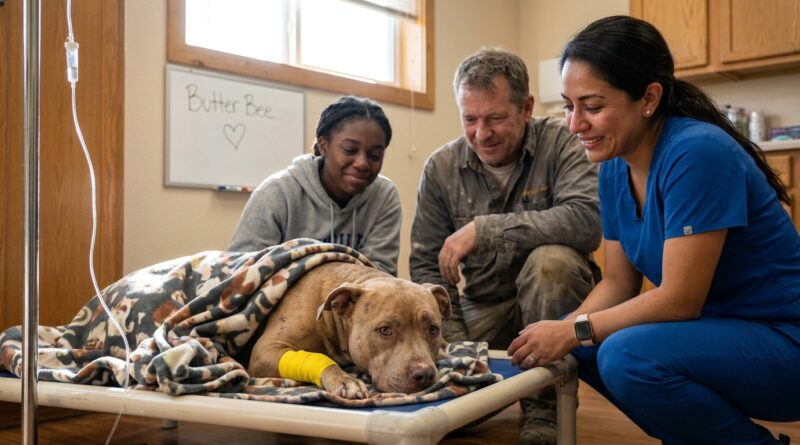
The Little Pit Bull Who Wouldn’t Give Up: Inside a ‘She Shouldn’t Have Survived’ Baltimore Street Miracle
Some days it really does feel like the world is stuck on repeat. Another ugly headline. Another story of cruelty. Another moment where you catch yourself wondering whether kindness still has any real weight. That is what makes Butter Bee’s story hit so hard. This little pit bull was found on the streets of Baltimore in horrifying condition, the kind that makes people say, “She shouldn’t have survived.” And honestly, by all normal odds, she probably should not have. But she did. Not because of one superhero. Not because of magic. Because a handful of ordinary people refused to keep walking. They stopped. They called. They carried. They paid attention. They gave her a chance to keep breathing long enough for help to catch up. If you have been needing one solid, real life miracle dog rescue story to remind you that compassion still exists in the wild, Butter Bee is it.
⚡ In a Hurry? Key Takeaways
- Butter Bee survived catastrophic abuse because strangers acted fast, got her to rescue support, and stayed involved.
- If you find an animal in crisis, start with safety, call local animal control or a rescue, document what you see, and move only if necessary.
- This story matters because it shows that miracles are often built by regular people doing small, practical things at the right time.
When “No One Could Help” Turned Out to Be Wrong
Butter Bee was discovered in brutal shape on a Baltimore street. Severely injured. Exhausted. In pain. The kind of scene that stops you cold.
People who work in rescue see heartbreaking cases all the time, but even seasoned hands looked at Butter Bee and knew she was right on the edge. She was the sort of dog people later describe with that stunned phrase, “I can’t believe she made it.”
But that sentence misses something important. She made it because people intervened.
That is the part many of us need to hear right now. Not every miracle arrives with trumpets. Sometimes it starts with one person deciding, “I’m not leaving this dog here.”
What Happened to Butter Bee
Reports around Butter Bee’s rescue describe a dog who had suffered severe trauma and neglect. She needed immediate stabilization, pain care, close monitoring, and the kind of patient handling that scared, injured animals often need before they can even begin proper treatment.
From there, the rescue process became a chain. Street-level discovery. Emergency response. Veterinary care. Ongoing support. Donations. Foster-style patience. Follow-up. Recovery.
That chain matters because any one broken link could have changed the outcome.
The first miracle was not medical
The first miracle was attention.
Someone noticed that Butter Bee was in real danger and treated that moment like an emergency. That sounds simple, but it is not. A lot of suffering continues because people assume someone else will handle it.
Here, somebody handled it.
The second miracle was time
Badly injured animals often run out of it. Fast.
Butter Bee got enough immediate help to stay alive long enough for the next step. That often means getting the dog warm, reducing stress, avoiding rough movement, and connecting with trained help right away.
The third miracle was persistence
Recovery from abuse is rarely one dramatic save and then a happy ending by dinner. It is slow. Expensive. Messy. Emotional. There are setbacks.
Butter Bee’s improvement came because people kept showing up after the adrenaline wore off.
Why This Real Life Miracle Dog Rescue Story Feels So Different
A lot of “feel-good” stories stay vague. They tell you to believe in hope, but they do not show you what hope actually looked like on the ground.
Butter Bee’s story does the opposite. It gives us a useful picture of what compassion looks like when it has dirt on its shoes.
- Someone paid attention.
- Someone made calls.
- Someone got her transported.
- Medical staff did the hard work.
- Supporters helped keep the effort going.
- People stayed long enough to see a broken dog become a dog again.
That is why stories like this land. They are not abstract. They give you a map.
If you need another reminder that animals can wind up at the center of astonishing timing and protection, The Miracle Dog Who Came Home Twice: Inside a ‘No Way He Could Have Found Us’ Story of Protection and Perfect Timing carries that same feeling of, “This should not have worked, but somehow it did.”
What To Do If You Ever Find an Animal in Crisis
This is where a painful story can become useful. If you come across an injured or abused animal, your job is not to become a vet on the sidewalk. Your job is to keep the situation from getting worse and get the right people involved.
1. Start with safety
An injured dog may be terrified, disoriented, or in enough pain to bite even if it is usually gentle.
Do this first:
- Keep traffic and bystanders back if possible.
- Approach slowly and from the side, not head-on.
- Speak softly.
- Do not crowd the animal.
2. Call for help right away
Contact local animal control, a nearby rescue, or an emergency vet. If cruelty is suspected, report that too. The more exact your location and description, the better.
Useful details to share:
- Exact location
- Type of animal and size
- Visible injuries
- Whether the animal is moving, bleeding, or trapped
- Whether the animal seems aggressive, scared, or unconscious
3. Document what you see
If it is safe, take a few photos or a short video. This can help responders prepare and may also matter if there is a cruelty investigation later.
Do not turn the moment into a social media event before you have called for real help.
4. Move the animal only if necessary
If the dog is in active danger, like traffic or extreme weather, and you can move it without putting yourself at serious risk, use a blanket, towel, or large coat as a barrier. Support the body as evenly as possible.
If there may be spinal or major orthopedic injuries, less movement is usually better until professionals advise you.
5. Skip home treatment unless instructed
Do not give human pain medicine. Do not pour random antiseptics on wounds. Do not offer food or water to an animal that may need surgery or could choke.
When in doubt, keep the dog calm, warm, and as still as possible.
6. Stay if you can
Sometimes the biggest help is simply being the witness who does not disappear. Rescuers may need someone to point out the location, explain what happened, or help confirm the timeline.
The Hard Truth About Rescue That People Rarely Say Out Loud
Stories like Butter Bee’s are hopeful, but they should not be mistaken for easy.
Rescue groups and veterinary teams often work with too little money, too little sleep, and too many emergencies stacked on top of each other. When one dog makes it, there are usually ten more waiting.
That is not meant to drain the hope out of this story. It is meant to sharpen it. Butter Bee survived because compassion got organized.
That is a useful lesson for the rest of us. Feeling bad is not the same as helping. Helping usually looks boring at first. It looks like phone calls, transport runs, paperwork, donations, fosters, and follow-through.
How Butter Bee Changed the People Watching
One reason these stories spread is that they do something to the people following them. At first you are horrified. Then guarded. Then you start checking for updates. Then one day you see the dog standing. Or eating. Or wagging a tail. And something in you unclenches.
That emotional swing matters.
People are tired. Compassion fatigue is real. It is hard to care deeply when everything feels broken all at once. A story like Butter Bee’s gives your brain a rare thing these days. Proof that intervention still matters.
Not guaranteed success. Not perfect endings every time. But real impact.
What “Miracle” Really Means Here
When people hear miracle, they sometimes think it means no effort, no process, no practical steps. But in stories like this, miracle usually means something else.
It means the situation should have gone one way, and instead it went another because enough people chose mercy over convenience.
That is not a smaller miracle. It is a sturdier one.
Butter Bee’s survival was not just about beating the odds. It was about what happened when ordinary people refused to let the odds make the decision.
At a Glance: Comparison
| Feature/Aspect | Details | Verdict |
|---|---|---|
| Why Butter Bee survived | Fast attention, emergency care, steady support, and people who did not give up after the first rescue moment. | A miracle built from action, not luck alone. |
| What bystanders should do | Protect the scene, call animal control or rescue, document injuries, and move the animal only if immediate danger makes it necessary. | Simple steps can buy life-saving time. |
| Big lesson for readers | You do not need special credentials to become the first link in a rescue chain. | Agency matters more than perfection. |
Conclusion
Right now a lot of people feel helpless watching the world come apart in public, and animal cruelty stories can be some of the hardest to carry. Butter Bee’s rescue does not erase that pain. It answers it. Here was an abused dog who by all appearances was headed toward becoming one more unbearable statistic. Instead, she was pulled from the brink, stabilized, and changed by the stubborn kindness of strangers. That is the value of this real life miracle dog rescue story. It gives you hope with fingerprints on it. It also gives you practical steps if you ever meet an animal in crisis. Most of all, it reminds you that miracles are often a chain of very normal people refusing to look away. You do not have to be a doctor or a pastor to be someone’s turning point. Sometimes you just have to stop, care, and make the call.