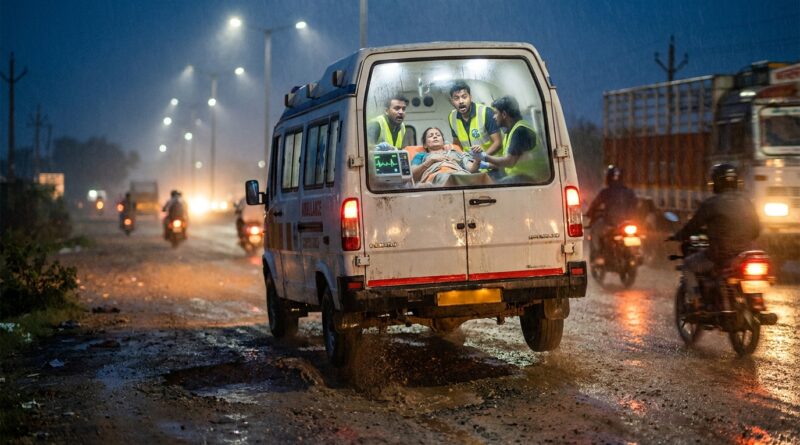
The Ambulance That Hit a Pothole: Inside a ‘She Was Gone, Then She Started Breathing Again’ Roadside Miracle
Some stories are annoying in the strangest way. Not because they are trivial, but because they refuse to fit into the neat boxes we use to make sense of life. A woman is thought to be gone. The ambulance carrying her hits a pothole. Then, somehow, she starts breathing again. If that makes you squint a little, you are not alone. Doctors tend to look for a physical explanation. Families tend to say, with tears in their eyes, that they witnessed a miracle. Most of us stand somewhere in the middle, wanting facts but also knowing that every now and then life serves up something that feels bigger than a chart, a scan, or a textbook. That is why this real life miracle ambulance pothole story sticks. It speaks to a fear many people carry quietly, that life is fragile and sudden, and to a hope they carry just as quietly, that maybe not everything is as final as it first appears.
⚡ In a Hurry? Key Takeaways
- This roadside story matters because it sits right at the edge of medicine, mystery, and human hope.
- If you hear a dramatic survival story, hold two thoughts at once. Respect medical facts, and leave room for the family’s lived experience.
- Do not treat miracle stories as medical advice. In any emergency, trained responders and fast care still matter most.
Why this story gets under your skin
There is a reason people keep sharing stories like this. They cut through the usual noise.
Most days, the news feels like a machine built to wear you down. More conflict. More anger. More reminders that bodies fail, roads break, systems miss things, and people vanish from ordinary life in an instant. Then a story like this shows up and throws a wrench into the script.
A woman is believed to be at the edge of death, or beyond it, depending on how the moment was understood. During transport, the ambulance hits a pothole hard enough to jolt the vehicle. After that jolt, she begins breathing again. If you are the family, you probably do not care whether the explanation ends up in a medical journal. You care that she was there, then gone, then somehow back.
If you are a doctor or paramedic, your brain goes somewhere else. Was there shallow breathing that was missed? A faint pulse? A temporary cardiac rhythm change? A mechanical jolt that acted, in effect, like a crude precordial thump? These are not cold questions. They are the questions medicine asks because lives depend on getting the details right.
What could have happened medically?
This is where it helps to slow down. “Impossible” stories sometimes turn out to be rare but explainable events.
A missed sign of life
In chaotic emergencies, especially outside a hospital, it can be hard to detect weak breathing or a thread-thin pulse. Lighting is bad. The road is rough. Emotions are high. Equipment has limits. Human beings have limits too.
That does not mean anyone did something wrong. It means emergency care is fast, stressful, and sometimes full of uncertainty.
A sudden jolt affecting heart rhythm
There is a long, debated idea in emergency medicine that a sharp blow at just the right moment can affect the heart’s rhythm. It is not something bystanders should ever try. It is not a home trick. But in theory, a violent bump in a moving ambulance could create enough force to change what was happening inside the chest.
That kind of explanation sounds dramatic because it is dramatic. It is also rare enough that most people, including many clinicians, may never see anything like it firsthand.
Autoresuscitation, also called the “Lazarus phenomenon”
Yes, this is a real term. It refers to the return of circulation after failed resuscitation efforts have stopped. It is uncommon, strange, and still not fully understood. Cases have been reported in medical literature. Some involve delayed effects from CPR, pressure changes in the chest, or medications that take longer than expected to circulate.
That does not prove this is what happened here. But it does remind us that medicine itself admits there are edge cases.
Why the family may still call it a miracle
Now let’s be honest about something. Even if doctors eventually land on a tidy explanation, families often hold on to a different truth.
They remember the timing. The phone call. The praying. The feeling that all hope had drained from the room. Then came the bump, the breath, the gasp, the look on someone’s face that said, “Wait. Did that just happen?”
You can explain a mechanism without erasing meaning.
That is where a lot of public arguments go wrong. One side thinks “miracle” means “ignore science.” The other side thinks “science” means “drain the wonder out of everything.” Real people usually do not live that way. They live in the overlap. They say, maybe there was a medical reason, and maybe it still feels like an answered prayer.
The real lesson in a real life miracle ambulance pothole story
The biggest value in a story like this is not proving one side right. It is giving people words for the moments that do not sit still.
Maybe you have seen a loved one rally after everyone thought the end had come. Maybe you have watched a monitor change and felt your knees go weak. Maybe you have been the skeptic in the room, only to witness something you still cannot fully file away.
That experience is more common than people admit.
Stories like this help communities talk about fear without falling apart. They help believers speak without being mocked. They help doubters ask fair questions without being painted as heartless. That is useful. More useful, frankly, than one more shouting match online.
What this story should not be used for
It should not be turned into bad advice.
No one should hear this and think rough motion is a treatment, or that bumpy transport can replace proper emergency care. It cannot. Emergency medicine works because trained people use skill, tools, timing, and procedure. Rare stories do not cancel that out.
Also, one account, however powerful, is still one account. Memory during trauma is not always precise. Details shift. Retellings grow cleaner than the moment really was. That is normal. It is human.
So the healthiest way to hold this story is with open hands. Let it be astonishing. Let it also stay complicated.
Why people keep passing these stories around
Because deep down, people want proof that the world is not only machinery.
Not proof in the laboratory sense. Proof in the human sense. Proof that every now and then something breaks through our tidy explanations and reminds us we are not fully in charge. For some readers, that points to God. For others, it points to the limits of current knowledge. For many, it points to both.
And maybe that is enough.
You do not have to flatten every mystery into a slogan. You also do not have to sneer at people for feeling awe. Awe is not ignorance. Sometimes it is just honesty.
At a Glance: Comparison
| Feature/Aspect | Details | Verdict |
|---|---|---|
| Medical explanation | Possible factors include missed weak signs of life, a rhythm change from the jolt, or rare autoresuscitation. | Plausible, but not always fully provable after the fact. |
| Family interpretation | The timing and emotional reality of the moment can make the event feel like answered prayer. | Completely understandable, even if doctors use different language. |
| Practical takeaway | Respect emergency medicine, avoid turning rare stories into DIY treatment ideas, and allow room for mystery. | Best way to hold the story with both care and common sense. |
Conclusion
People are tired. Tired of outrage, tired of grim headlines, tired of pretending life feels sturdier than it really does. That is why a real life miracle ambulance pothole story lands so hard. It gives shape to the moments that feel written by something larger than biology, even when biology still has a lot to say. The doctors can keep asking good, careful questions. The family can keep saying thank you. Both responses make sense. And when we let both sit in the same room, we end up with something rare these days. Not perfect agreement, but shared humility. We have all seen things we cannot fully explain. Sometimes admitting that is exactly what helps a community breathe a little easier.