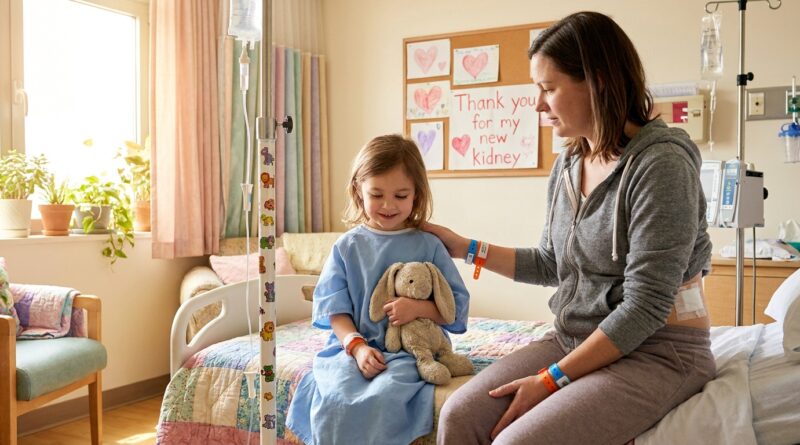
The Best Friend Who Gave Her Kidney: Inside the Valentine’s Day Miracle That Let a 5‑Year‑Old Be a Kid Again
When you are raising a medically fragile child, life can shrink to lab numbers, medication times and the sound of machines telling you whether to panic. It is exhausting. It is lonely. And when a transplant is the only real path forward, every day on a waitlist can feel like its own kind of heartbreak. That is why this real life miracle story kidney transplant from friend hits so hard. It is not polished or distant. It is deeply human.
In Missouri, a 5-year-old girl finally got the chance to be a kid again because her mother’s best friend did something extraordinary. She quietly got tested. She turned out to be a perfect match. Then, on Valentine’s Day, she donated her kidney. For families who are living in the middle of fear and uncertainty, this story matters because it shows that help can come from a place much closer than expected. Sometimes the miracle is not a sudden fix from nowhere. Sometimes it is a person who loves you enough to say yes.
⚡ In a Hurry? Key Takeaways
- A Missouri mom’s best friend became a living kidney donor for her 5-year-old daughter after testing revealed a perfect match.
- If your family is facing transplant questions, ask early about living donation, compatibility testing and how friends can help in safe, approved ways.
- This is a hopeful story, but every transplant case is different. Medical decisions should always go through the child’s care team and transplant center.
Why this story feels so personal to so many families
Parents of sick kids often carry a private fear they do not always say out loud. What if love is not enough. What if I do everything right and my child still has to wait. What if help never comes in time.
That is what makes this story more than a feel-good headline. It speaks to the families sitting in parking garages after appointments, answering texts with one hand while checking medication doses with the other. It gives shape to something many people need badly right now. Proof that impossible situations do sometimes shift.
Not because the system suddenly gets easy. Not because fear disappears. But because ordinary people step forward.
The Valentine’s Day gift that changed a child’s life
The heart of this story is simple, and that is part of why it is so powerful. A little girl in Missouri needed a kidney. Her mother’s best friend chose to get tested. She did not just offer nice words or say, “Let me know if you need anything.” She took a real step.
That step mattered.
Testing showed she was a perfect match. On Valentine’s Day, she donated her kidney, giving the child a real chance at health, energy and the ordinary joys that many families take for granted. Playing. Running. Going through a day without every moment being shaped by illness.
For a child, “getting better” is not just a medical phrase. It means room to grow up.
What a living kidney donation really means
For non-medical readers, a living kidney donation can sound almost unreal. Most people are surprised to learn that a healthy person can donate one kidney and still live a full life with the other. It is not casual, and it is not risk-free. Donors go through careful screening, medical exams and long conversations with specialists to make sure donation is a safe and informed choice.
That is important. Stories like this are moving, but they are not reckless acts of emotion. They are built on medicine, testing and a lot of careful planning.
Why a “perfect match” matters
When people hear that phrase, they usually think it means instant success. In real life, it means the donor was highly compatible based on blood type, tissue markers and other transplant checks. Better matches can improve outcomes, though transplant teams look at many factors before surgery is approved.
So yes, this was emotional. But it was also medical, practical and very real.
Why families ask about living donors
Waitlists can be long. Children can get sicker while waiting. A living donor can sometimes speed up the path to transplant, depending on the case and the center. It also gives the medical team more control over timing, preparation and follow-up care.
That does not make the process easy. It just makes hope feel a little less abstract.
The quiet courage behind the friend’s decision
There is a difference between sympathy and sacrifice. Both matter, but they are not the same.
This friend did not stop at feeling bad for the family. She entered the process. She let doctors evaluate her. She accepted the seriousness of surgery. She stepped into discomfort so a little girl could step out of suffering.
That kind of courage often looks surprisingly plain from the outside. There may be no dramatic speech. No big announcement. Just a person deciding, day by day, to keep going through the next form, the next test, the next appointment.
That is often how modern miracles work. Quietly.
What this story teaches families who are still in the waiting room
If you are caring for a child with a major medical condition, this story may stir up a lot. Hope, yes. But maybe grief too. Maybe anger. Maybe the question of why one family got the call, the match or the breakthrough and yours is still stuck.
That response is normal.
Hopeful stories can hurt when you are in the middle of your own hard chapter. But they can also offer something useful. A reminder to keep asking questions. Keep learning your options. Keep letting trusted people know what is actually going on.
Practical lessons worth holding onto
First, people in your circle may want to help more than you realize, but they may not know what is medically useful. Being specific matters.
Second, asking about living donation is not pushy or selfish. It is a fair medical question. Families can ask transplant teams how the process works, who can be tested and what protections are in place for donors.
Third, support is bigger than surgery. Even if someone cannot donate, they may be able to help with meals, rides, child care, fundraising or simply showing up consistently.
How friends and neighbors can become part of the miracle
Many people want to help a family in crisis, but they freeze because they are afraid of saying the wrong thing. Here is the good news. Help does not have to be dramatic to count.
If you are close to a family facing transplant
Start with honesty. Ask what would truly lighten the load.
That might mean:
Driving siblings to school.
Handling a grocery run.
Sitting with a parent during an appointment.
Learning about living donation through the approved medical team, if that is something you genuinely want to explore.
The key is this. Do not make the family manage your feelings too. Offer clear, concrete help.
If you are thinking about being tested
Go through the transplant center, not through guesswork on social media. The center can explain eligibility, screening, privacy and risks. A person should never feel pressured into donation, and a family should never feel responsible for persuading anyone.
Healthy help has boundaries. Good transplant teams protect those boundaries.
Why stories like this matter beyond one family
We are all a little worn down by bad news. That can make us suspicious of uplifting stories, as if hope must be fake to be shareable. But some stories earn their place because they show what people are still capable of doing for each other.
This one does that.
It reminds us that medicine is not only about procedures and charts. It is also about community, timing, trust and human choice. A friend chose to move from concern to action, and a child’s future changed because of it.
If this kind of story speaks to you, you may also connect with The Mother Who Refused To Say Goodbye: How a Daughter’s Desperate Prayer Saved a Failing Kidney, which captures that same raw place families enter when kidney failure turns everyday life upside down.
At a Glance: Comparison
| Feature/Aspect | Details | Verdict |
|---|---|---|
| Type of miracle | A real life kidney transplant made possible by a family friend who became a living donor. | Hopeful and grounded in real medical care. |
| What made the difference | The friend chose to get tested, was found to be a perfect match and followed through with donation on Valentine’s Day. | A powerful example of action, not just good intentions. |
| Reader takeaway | Families can ask better transplant questions, and communities can support in practical, safe ways. | Useful for both caregivers and would-be helpers. |
Conclusion
This story lands right where many families are living now, in that hard space between fear and endurance. A 5-year-old Missouri girl got a second chance because her mom’s best friend quietly got tested, turned out to be a perfect match and donated her kidney on Valentine’s Day. That does not erase the terror that came before it. But it does show that love can take practical form. It can fill out paperwork, sit through testing and walk into surgery. More than a feel-good headline, this is a picture of courage with its sleeves rolled up. It reminds us to ask hard medical questions, to stay open to help and to remember that friends and neighbors can become part of an outcome that once looked impossible. In a season full of noise and outrage, this is a grounded reminder that miracles still happen, often through ordinary people who quietly decide to say yes.