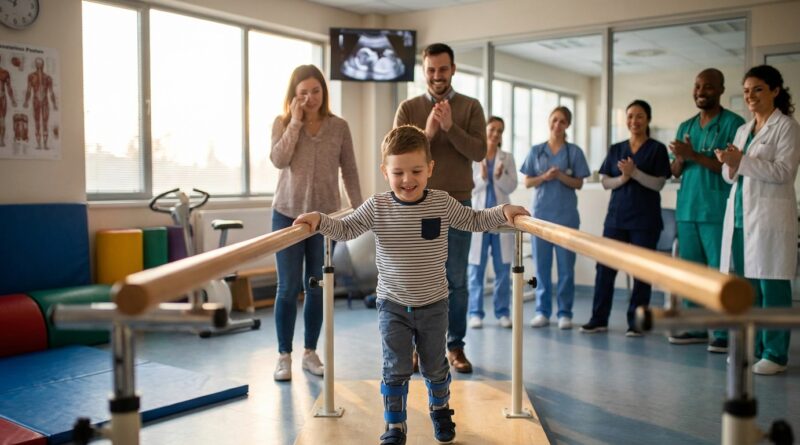
‘A Real-Life Miracle’: How One Little Boy Walked Into a Future No Doctor Could Promise
Some days the news feels like a wall of worst-case scenarios. If you are a parent staring at a diagnosis, that kind of fear can sink in fast. You hear percentages, limitations and careful phrases like “we just don’t know,” and it can sound like the future has already been decided. That is why this story hits so hard. A little boy from Northern California was diagnosed before birth with severe spina bifida, a condition that often comes with life-changing mobility challenges. His family faced a choice that sounded almost impossible. They agreed to a risky fetal surgery that used stem cells while he was still in the womb. No one could promise what would happen next. And yet, years later, this boy is learning to walk. Not as a polished headline. As a real child, in a real family, with scars, therapy, effort and hope all mixed together.
⚡ In a Hurry? Key Takeaways
- This real life miracle boy walks after fetal stem cell surgery story shows that one severe prenatal diagnosis did not define the final outcome.
- If you are facing a serious diagnosis, ask your care team about clinical trials, specialty centers and second opinions before assuming the first prognosis is the whole story.
- Breakthrough treatment is not a guarantee, and it is not right for every family, but informed hope is far better than fear alone.
When a prognosis feels like a sentence
Spina bifida happens when the spine and spinal cord do not form properly during pregnancy. In severe cases, doctors may warn parents about possible paralysis, bowel and bladder problems, hydrocephalus and long-term disability. Those warnings matter. Families deserve honesty.
But honesty is not the same thing as certainty.
That is the lesson in this boy’s story. His parents were told their son had a severe form of spina bifida before he was born. They were not handed easy answers. They were handed risk. Risk if they did nothing. Risk if they tried surgery. Risk either way.
For many parents, that is the hardest part. You are asked to make a huge decision while scared out of your mind.
The surgery that changed his path
This case stood out because doctors did more than a standard fetal repair. The boy underwent in-utero surgery that included stem cells, an approach designed to help protect and support spinal cord tissue before birth. That matters because with spina bifida, ongoing damage can happen during pregnancy as exposed nerves are affected by the environment in the womb.
The basic idea is surprisingly simple to explain, even if the medical work is incredibly advanced. Surgeons try to close the spinal defect before birth. In this case, they also used specially prepared stem cells on a patch placed over the repair, with the hope of improving healing and function.
No one had a crystal ball. They still do not. Medicine rarely works that way.
What they had was a serious problem, a bold treatment plan and a team willing to try something new in a careful, research-based setting.
Why fetal treatment matters
Traditional surgery after birth can help protect exposed tissue, but it cannot undo every injury that happened before delivery. Fetal surgery aims to reduce further harm earlier. That does not mean a cure. It means a better chance in some cases.
That distinction is important. Families need hope they can stand on, not hype.
Why people are calling it a real-life miracle
Years later, the result is what catches people off guard. The little boy is learning to walk.
Not because someone promised a perfect outcome. Not because every case will look like his. But because sometimes the line between medical breakthrough and miracle gets very thin when you are watching a child do something experts once doubted he would do.
That word, miracle, can make some people uncomfortable. Fair enough. It means different things to different people. For some, it points to faith. For others, it means a rare and beautiful outcome that statistics did not fully capture. In everyday life, both ideas can sit side by side.
What makes this story powerful is that it does not ask you to deny science. It asks you to remember that science itself can open doors no one had before.
What families can take from this story
If you are dealing with a tough diagnosis, this story is not telling you to ignore your doctor. It is telling you to keep asking good questions.
1. A prognosis is a map, not a verdict
Doctors use data from many past patients to guide families. That is useful. But your child is not a spreadsheet. Some outcomes are worse than expected. Some are better. Most are more complicated than one sentence can capture.
2. Specialty centers can make a huge difference
Rare or high-risk conditions often need teams with deep experience. That can include maternal-fetal medicine experts, pediatric neurosurgeons, rehabilitation specialists and research teams running clinical trials.
If you are overwhelmed, start small. Ask:
- Is there a fetal treatment center or major children’s hospital that handles cases like this?
- Are there any clinical trials or newer treatment options we should know about?
- Can we get a second opinion before making a final decision?
3. Progress after birth still takes work
Stories like this can sound instant when they are squeezed into headlines. Real life is slower. A child learning to walk after severe spina bifida and fetal surgery likely still has years of therapy, follow-up care, checkups and setbacks. That does not make the progress less meaningful. It makes it more real.
Science, courage and ordinary family love
One reason this story lands so deeply is that it is not only about medicine. It is about parents making an impossible choice with limited guarantees. It is about surgeons willing to carry the weight of that risk. It is about researchers building on years of work that most of us never see.
And it is about a child doing the hard, unglamorous stuff afterward. Trying again. Taking another step. Falling. Getting back up.
That part matters. We sometimes talk about breakthroughs as if the operation is the whole story. It is not. The family is part of the treatment too. So is the rehab team. So is time.
What this does not mean
It does not mean every child with spina bifida will walk after fetal stem cell surgery. It does not mean experimental treatment always works. It does not mean families should feel guilty if a certain option is not available, affordable or medically safe for them.
It simply means this. Grim odds are not the same as guaranteed outcomes.
That is a small sentence, but if you are scared, it can feel like oxygen.
Why stories like this matter right now
A lot of health coverage leans hard on fear. Sometimes for good reason. Illness is serious. Disability is serious. Medical risk is serious. But people also need stories that show what is possible without pretending everything turns out neatly.
This story gives readers something more useful than vague inspiration. It gives a concrete example of what it looks like when advanced medicine, brave parenting and plain old persistence meet. It reminds people that hope is not the opposite of realism. Sometimes hope is the only thing that keeps a family moving long enough to find the next option.
At a Glance: Comparison
| Feature/Aspect | Details | Verdict |
|---|---|---|
| Prenatal diagnosis | Severe spina bifida was found before birth, with major concerns about future mobility and health. | Serious, but not a final script for life. |
| Fetal stem cell surgery | Doctors repaired the spinal defect in the womb and used stem-cell-based support as part of an advanced treatment approach. | Promising and groundbreaking, but still high-risk and specialized. |
| Outcome so far | The boy is learning to walk, showing function beyond what many feared at diagnosis. | A powerful reminder that prognosis is not prophecy. |
Conclusion
People are tired of stories that treat medical odds like the end of the conversation. This one does the opposite. A Northern California boy was diagnosed before birth with severe spina bifida, went through risky fetal stem cell surgery and is now learning to walk. That does not erase the danger, the uncertainty or the work still ahead. It does show what can happen when science, courage and something bigger than all of us meet in the same room. For parents, caregivers and patients, that matters. It is a real picture of hope with its sleeves rolled up. And maybe that is the part worth holding onto. A prognosis can guide a plan, but it does not own the future. Real-life miracles do not always look perfect. Sometimes they look like one hard-won step after another.