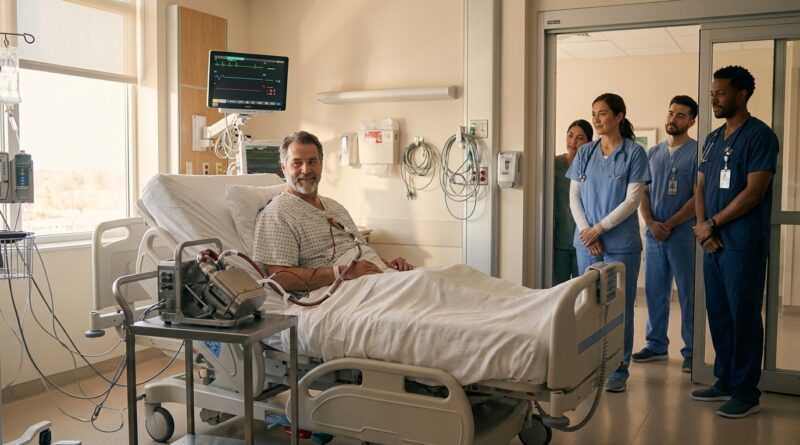
The Man Who Lived Without a Heart: The Real-Life Medical Miracle Doctors Still Can’t Explain
You can be forgiven for rolling your eyes at the word miracle. Most of us have seen too many headlines that promise something stunning, then fall apart the minute you look closer. That is what makes the man who lived without a heart true story so gripping. It is not a vague rumor. It is a real medical case involving a real patient, real surgeons, and a machine that kept him alive after his failing heart was removed. For a period of time, he had no human heart in his chest at all. Instead, doctors used a total artificial heart to do the job while he waited for a donor transplant. Science explains the hardware. It does not fully explain why some people survive odds this brutal while others do not. That is where this story lands with so much force. It is medically solid, deeply human, and for many people, impossible to hear without feeling that something bigger may still be at work.
⚡ In a Hurry? Key Takeaways
- This true story is about a man kept alive by a total artificial heart after his own heart was removed, not a made-up internet legend.
- If you read miracle health stories, look for named hospitals, known devices, and clear medical timelines before believing the headline.
- The lesson is not to ignore science. It is that modern medicine, human grit, and faith can sometimes meet in ways that still leave room for awe.
The Story That Sounds Too Wild to Be True
When people hear “a man lived without a heart,” the first reaction is usually disbelief. Fair enough. It sounds like one of those exaggerated stories that got stretched a little more each time it was shared.
But this case is different. In several widely reported medical cases over the years, patients with end-stage heart failure had their own hearts removed and replaced temporarily with a total artificial heart. This machine did not just assist the heart. It took over the heart’s job completely.
That distinction matters.
A pacemaker helps regulate rhythm. A ventricular assist device helps a weak heart pump. A total artificial heart steps in when the natural heart is gone or cannot be saved. Blood still circulates. Oxygen still gets delivered. The person can remain alive, conscious, and in some cases even mobile while waiting for a transplant.
So, Did He Literally Live Without a Heart?
Yes, with one important clarification. He did not live without circulation. He lived without a biological human heart.
That is what makes the phrase both shocking and true.
In these cases, surgeons removed the failing ventricles and connected an artificial heart system in their place. The device pumped blood to the lungs and the rest of the body. The patient was alive because the machine was doing the work the human heart normally does.
To a doctor, that is advanced cardiac support. To the average person, it feels like standing at the edge of what we thought was possible.
What a Total Artificial Heart Actually Does
Think of the heart as the body’s pump station. If it stops, every organ is in trouble fast. A total artificial heart is built to copy that pumping action.
It usually includes:
- Artificial pumping chambers
- Valves that control blood flow direction
- Tubes connecting to major blood vessels
- An external driver or power source that keeps the system working
It is not a cure by itself in most cases. It is often used as a bridge to transplant. In plain English, it buys time. Sometimes that time is the difference between death and a second chance.
Why Doctors Were So Stunned
Cardiac surgeons are not easily shocked. They work around life-and-death moments every day. Yet cases like this still stand out because so many things have to go right at once.
The surgery has to succeed. The body has to tolerate the device. Infection has to be avoided. Other organs, especially the brain, kidneys, and lungs, have to keep functioning. Then the patient has to survive long enough for a donor heart to become available.
That is a brutal chain of ifs.
And even when the medicine is first-rate, there is still something hard to pin down. Why does one person hold on through impossible complications while another person with a similar case slips away? Doctors can measure pressure, oxygen, clotting, and blood flow. They cannot fully measure the mystery of survival.
The Human Side We Often Miss
Stories like this can get reduced to machinery. Tubes. pumps. monitors. ICU charts. But at the center of it was a person, frightened and fragile, surrounded by family members who had to absorb words no one ever expects to hear.
Your loved one’s heart is failing.
We may have to remove it.
A machine may keep him alive.
That does not feel like science fiction when you are the one standing in the hospital room. It feels like terror mixed with hope, one minute at a time.
That is one reason people use the word miracle. Not because they are ignoring medicine, but because medicine itself can bring you right up to the edge of wonder.
Science and Faith Are Not Always Opposites
This is where a lot of people get stuck. They think they have to choose one side. Either this was a triumph of medical engineering, or it was something sacred. But real life is usually more honest than that.
Doctors spent years building the tools. Surgeons trained for decades to use them. Nurses watched every detail. Technicians kept systems running. And still, many families in these moments pray. A lot.
That is not hypocrisy. It is humanity.
People have always reached for both skill and hope when the stakes are high. If anything, stories like this show how the two can sit in the same room. One keeps the body going. The other keeps the soul from collapsing.
If that idea speaks to you, you might also like The Girl Swept Out to Sea Who Refused to Let Go: A Real-Life Miracle of Survival. It has that same rare mix of hard facts and jaw-dropping endurance.
Why This Story Still Hits So Hard
Part of it is the image. A person alive without a human heart sounds almost biblical, or at least beyond normal language.
But part of it is what the story answers in us.
People are tired. Tired of outrage. Tired of fake inspiration. Tired of stories that sound moving until you realize they were polished for clicks. This one cuts through all that because it is concrete. There was a patient. There was a machine. There were doctors. There was a result no one could take for granted.
And because it is real, it gives something better than cheap inspiration. It gives perspective.
What Perspective?
That the human body is fragile, but not simple.
That medical technology can do things our grandparents would have called impossible.
That survival is sometimes a team effort between engineering, expertise, timing, and stubborn human will.
And that even in the most technical hospital setting on earth, people still whisper prayers.
How to Tell a Real Miracle Story From Clickbait
If you want one practical takeaway from this, here it is. You do not have to be cynical, but you should be careful.
Look for These Signs
Named medical institutions. Real stories usually point back to actual hospitals or clinical reports.
Specific devices or procedures. “Artificial heart” should mean something precise, not just dramatic wording.
A clear timeline. What happened first, what treatment was used, and what the outcome was.
No fuzzy claims. If an article says doctors were “left speechless” but names no doctor, be skeptical.
Room for complexity. True stories usually include risk, uncertainty, and limits. Fake ones tend to sound too neat.
This case passes that test. It is dramatic, yes. But it is also grounded in known heart-replacement technology and documented medical practice.
What “Doctors Still Can’t Explain” Really Means
It does not mean doctors are clueless. It means medicine can explain the mechanism without fully exhausting the meaning.
Doctors can explain how an artificial heart pumps blood. They can explain how a transplant works. They can explain why the patient was dying and what intervention bought time.
What they cannot fully explain is the deeper question many readers are actually asking. Why do some lives turn at the exact last second? Why do some people endure more than the charts suggest they should? Why does one impossible case become a survival story?
That is where science reaches its edge. Not because it fails, but because it was never designed to answer every human question.
At a Glance: Comparison
| Feature/Aspect | Details | Verdict |
|---|---|---|
| Core claim | A man survived for a period with no biological heart, using a total artificial heart | True, with medical context |
| Medical basis | End-stage heart failure, surgical removal of the failing heart, machine support while awaiting transplant | Scientifically solid |
| Why people call it a miracle | The survival odds, timing, emotional weight, and successful outcome feel far bigger than a headline can capture | Reasonable, even if you prefer medical language |
Conclusion
The man who lived without a heart true story stays with people because it is not just “good news.” It is stronger than that. It is a reminder that even in a world full of war, politics, noise, and shallow optimism, there are still stories that feel solid enough to lean on. A real man. A real machine. Real doctors. A real outcome few would have dared predict. That does not ask you to reject science. It asks you to see how astonishing science already is, and to leave a little room for wonder too. Human life is tougher than we think. Technology can stand beside faith without canceling it out. And if you have been afraid that believing in the impossible makes you foolish, this story says otherwise. Sometimes the impossible is not fantasy. Sometimes it is waiting in a hospital room, hooked up to wires, still alive.