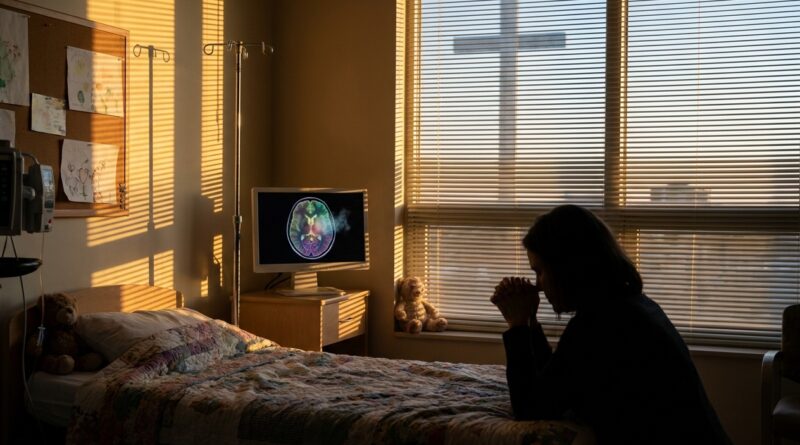
The Girl Whose Tumor Vanished Overnight: Inside a Modern ‘Doctors Can’t Explain It’ Miracle
When you are staring at scans, lab numbers, or a doctor whose face tells the story before their words do, miracle talk can feel cruel. It is easy to believe God still helped people in Bible times, or helped somebody else’s cousin in a story from years ago, but not here. Not now. Not in a hospital room that smells like sanitizer and fear. That is why one recent, medically documented case keeps catching people’s attention. It is the story of a little girl whose aggressive brain tumor appeared to vanish so suddenly that even the doctors involved admitted they could not fully explain what happened. This is not gossip passed around a prayer chain. It is a modern case tied to scans, specialists, and hard medical facts. And for families praying through bad news, it offers something rare. Not a guarantee, but a reason to whisper, with trembling honesty, “Maybe God still does this.”
⚡ In a Hurry? Key Takeaways
- This true miracle story tumor disappeared doctors can’t explain centers on a young girl with a usually fatal brain tumor that dramatically regressed against expectations.
- If you are in a medical crisis, keep praying, but also keep every appointment, ask for copies of scans and notes, and get a second opinion when needed.
- Stories like this should build hope, not guilt. A miracle in one case does not mean someone failed if healing comes differently.
The case people keep calling a miracle
The story most often pointed to here is that of a young girl diagnosed with diffuse intrinsic pontine glioma, often shortened to DIPG. It is one of the most feared childhood brain cancers. DIPG grows in the brainstem, which controls basic life functions. Because of where it sits, surgery is usually not an option. Prognosis is often devastatingly short.
That is what makes this case hit so hard. The family was not dealing with a minor mass or a suspicious shadow on a scan. They were facing a diagnosis that has broken countless families. Doctors knew what this kind of tumor normally does. They also knew what it normally does not do.
Why DIPG is such a frightening diagnosis
If you have never heard of DIPG before, here is the plain-English version. It is a tumor in one of the worst possible spots. The brainstem is like the body’s control hub for breathing, swallowing, movement, and other basic functions. A tumor there can change a child’s ability to walk, talk, eat, and eventually survive.
For years, treatment options were painfully limited. Radiation may buy time or reduce symptoms for a while, but true long-term recovery has been extremely rare. So when doctors tell parents what comes next, they usually do it gently, because the statistics are brutal.
What reportedly happened
In this case, the girl underwent the kind of treatment doctors would normally use to try to slow the disease, not erase it overnight. Then something deeply unusual happened. Follow-up imaging showed dramatic tumor regression, far beyond what the medical team would typically expect.
That is where people start using words like “miracle.” Not because doctors are careless with evidence, but because the evidence itself became hard to fit inside the usual script. The tumor response appeared out of proportion to expectations. The child improved. The scans changed. The people trained to predict decline were suddenly dealing with improvement.
What doctors mean when they say, “We can’t explain it”
This matters. “Can’t explain” does not always mean “there is no possible scientific mechanism anywhere.” It usually means the result does not fit what doctors would reasonably predict from the diagnosis, timing, and treatment course.
Medicine is honest when it is at its best. Good doctors know the difference between “we know exactly why this happened” and “we have observed it, documented it, and it still surprises us.” Those are not the same thing.
In other words, this was not a case of somebody avoiding hospitals, drinking herbs in secret, and then posting a blurry testimony online. This was a child under medical care, with scans and specialists involved, whose outcome pushed beyond what many would expect.
Could there be a medical explanation?
Possibly. And saying that does not weaken the wonder of the story.
Sometimes diagnoses are refined
Brain tumors can be complex. In some cases, newer testing can reveal that a tumor behaves differently than first thought. Medicine learns more every year, especially with pediatric cancers.
Sometimes a rare treatment response happens
Rare does not mean impossible. Some tumors respond in ways that are uncommon enough to shock even experienced doctors.
Sometimes “unexplained” stays unexplained
And this is the part many families understand in their bones. Not every stunning recovery gets neatly filed away. Some are still discussed years later because they do not sit comfortably in the usual pattern.
Why people of faith call this more than luck
Faith does not require us to hate medicine. In many Christian families, prayer and treatment walk side by side. People pray in waiting rooms, then sign consent forms. They ask elders to pray, then drive to radiation appointments. They cry out to God, then listen carefully to pediatric oncologists.
That is why stories like this land so deeply. They do not ask you to choose between science and prayer. They sit right in the middle of both. The doctors did their work. The family prayed. And the outcome was far better than expected.
What this story gives families who are still waiting
If you are caring for a sick child, or love someone who is, you already know the hardest part is often the waiting. Waiting for pathology. Waiting for the next MRI. Waiting for the specialist to call back. Waiting while your mind runs ten years ahead into dark places.
This kind of story gives language to that waiting.
It says you are not foolish for praying even after a bad diagnosis. It says you are not weak for hoping when the numbers look awful. It says the final sentence has not always arrived when people thought it had.
Just as important, it protects you from a fake kind of hope. Real hope does not deny scans or pretend medicine does not matter. Real hope looks right at the chart and still says, “God, if You want, You can.”
What this story does not mean
It does not mean every child with the same diagnosis will be healed in the same way.
It does not mean families whose loved ones die did not pray hard enough.
It does not mean you should stop treatment and wait for a supernatural turnaround.
That last point is important. The healthiest way to read a medically baffling healing story is this: keep praying, keep showing up, keep asking questions, keep using the care available to you.
If you are in the middle of your own medical crisis
Here are a few steadying steps that help when life feels like it is spinning.
1. Ask for the facts in writing
Request copies of scan reports, pathology reports, lab work, and visit summaries. When fear is high, memory gets fuzzy fast.
2. Get a second opinion
This is not insulting to your doctor. It is normal, especially with serious or rare diagnoses.
3. Let prayer be specific
Instead of only praying “Lord, help,” pray for clear scans, wise doctors, strength for caregivers, manageable side effects, peace in the night, and courage for the next appointment.
4. Build a small support circle
Pick a few people who can handle updates without creating drama. You do not need to carry every conversation while trying to survive.
5. Leave room for both tears and faith
You do not have to sound brave every minute. Honest prayer is still prayer.
Why recent miracle stories matter so much
People are tired of vague claims. They want something grounded. Something recent. Something with enough detail to survive the first hard question.
That is why this true miracle story tumor disappeared doctors can’t explain has spread so widely. It feels close enough to touch. It happened in the age of modern imaging, specialists, and documented follow-up. It is not buried in the fog of history. It happened in a world that can scan, measure, compare, and still end up surprised.
Hope needs honesty to stay healthy
There is a difference between encouragement and hype. Hype says every story must end with a dramatic turnaround. Encouragement says God is still at work, even when we do not fully understand how, when, or why.
This case belongs in that second category. It invites wonder without demanding denial. It lets grieving and hopeful people breathe in the same room.
At a Glance: Comparison
| Feature/Aspect | Details | Verdict |
|---|---|---|
| Medical documentation | The case is tied to real diagnosis, imaging, specialist care, and follow-up rather than rumor alone. | Strong reason people take it seriously |
| Why it feels miraculous | The degree and timing of tumor regression appear far outside what many expect from a disease like DIPG. | Genuinely baffling, even with medical caution |
| Takeaway for families | Pray boldly, stay engaged with doctors, and do not confuse one miracle story with a promise of identical outcomes. | Best balance of faith, wisdom, and realism |
Conclusion
For families sitting in children’s wards, sleeping in chairs, checking phones for results, or trying not to cry in the parking lot, stories like this matter. They do not erase the fear. They do not cancel the diagnosis. But they do push back against that heavy lie that says everything has already been decided. A fresh, medically baffling healing story gives more than optimism. It gives words for prayer when statistics say to stop asking. It reminds people that medicine can be honest and faith can still be alive. And for anyone whispering through clenched teeth for a son, daughter, spouse, or parent, this story says something precious. God may still move in hospital rooms today, not only in some distant past.