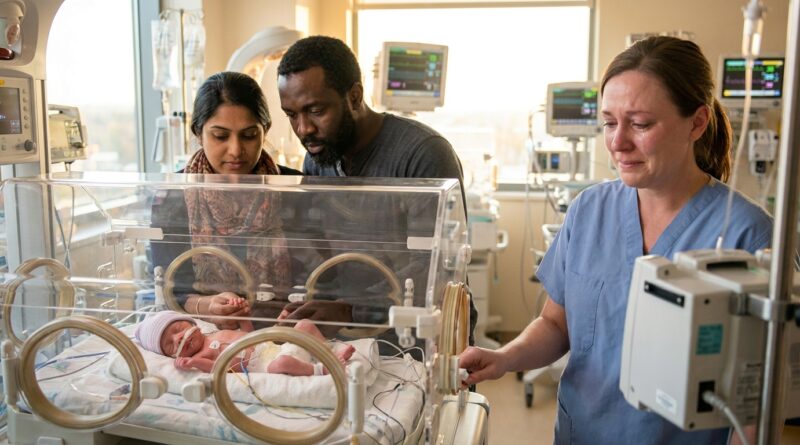
The Baby Who Wasn’t Supposed To Take A Breath: How A ‘No Chance’ Diagnosis Turned Into A NICU Miracle
There is a special kind of pain in hearing a doctor say your baby may not survive. It freezes the room. Then it follows you home. Parents in that spot often do the same few things. They replay every scan result. They search for one more answer at 2 a.m. They try to prepare for goodbye while still hoping for hello. That is why a real life NICU miracle baby story matters so much. Not because it promises that every hard case ends well, but because it shows what can happen when a baby does something no chart fully predicted. In this case, a child who was not expected to take a breath at all entered the world, breathed, fought through the NICU, and slowly began turning a “no chance” diagnosis into a story of survival. For families living minute to minute, that kind of story is not fluff. It is something solid to hold.
⚡ In a Hurry? Key Takeaways
- This story shows that even after a devastating prenatal diagnosis, some babies still surprise everyone at birth and in the NICU.
- Ask clear questions about breathing support, immediate delivery plans, comfort care versus full intervention, and what changes doctors would watch for after birth.
- Hope is not the same as denial. A rare good outcome does not erase medical risk, but it can help families make informed choices with less fear and more clarity.
When “No Chance” Is the Starting Point
Some diagnoses land like a door slamming shut. Parents are told the lungs are too underdeveloped. Or the fluid levels are too low. Or the anatomy scan shows problems so severe that survival outside the womb seems almost impossible.
In cases like this, doctors are not being cruel when they speak bluntly. They are trying to prepare a family for what they believe is most likely. But “most likely” is not the same thing as “guaranteed.” That small gap is where some of the most astonishing NICU stories begin.
The baby at the center of this story was expected, by all reasonable medical judgment, not to breathe after delivery. The outlook was grim. Plans may have leaned more toward comfort than rescue. Family members braced for minutes, not milestones.
Then the baby was born. And breathed.
Why Breathing Matters So Much in These Cases
For many newborns with severe prenatal complications, the first question is brutally simple. Can the baby oxygenate at all?
If a baby is not expected to breathe, it usually means doctors are worried about one of a few major problems:
- Lungs that did not develop enough during pregnancy
- A condition that physically limits breathing after birth
- Severe prematurity or birth trauma
- Complications linked to low amniotic fluid, structural issues, or genetic conditions
That first breath is not just symbolic. It tells the team whether the baby has a fighting shot. Sometimes one breath becomes a few. Then comes oxygen support. Then monitoring. Then a day in the NICU. Then another.
This is how “not expected to survive” can slowly turn into “still here.”
The NICU Miracle, and What It Really Looks Like
People hear the word miracle and picture one dramatic moment. Real NICU miracles are often messier than that.
They look like alarms, tubes, skin so fragile it scares you to touch it, and parents learning a whole new language in a matter of hours. Saturation. CPAP. Vent settings. Blood gases. Brady events.
They also look like tiny wins that outsiders might miss. A stable temperature. Less oxygen than yesterday. One good feeding attempt. Fewer episodes overnight. A doctor saying, “We’re cautiously encouraged.”
That is what makes a real life NICU miracle baby story so powerful. It is not magic in place of medicine. It is a baby responding better than expected, with skilled care meeting fierce determination.
What stunned the staff
In stories like this, the surprise usually comes in stages. First, the baby is alive at delivery. Then the baby tolerates breathing support. Then the baby survives the dangerous first days. After that, the tone in the unit can begin to shift. Not to certainty. NICU teams know better than that. But to possibility.
That shift matters. Once a baby shows signs of strength, the care plan may expand. More testing. More active respiratory support. Nutrition strategies. Closer tracking of growth and neurological response. Every new sign of resilience can open one more door.
What Parents Can Ask When the Prognosis Looks Impossible
Families in this position are often too overwhelmed to know what to ask. That is normal. It helps to keep the questions simple and practical.
Questions for the prenatal team
- What exactly is making you say survival is unlikely?
- Is the biggest concern breathing, brain function, heart function, or a mix of several things?
- Are there any outcomes, even rare ones, where babies do better than expected?
- What would delivery day look like if we choose full intervention?
- Would a higher-level NICU change the options?
Questions for the NICU team after birth
- What surprised you most after delivery?
- What signs in the first 24 hours matter most?
- What kind of breathing support is being used, and why?
- What would count as progress this week?
- What setbacks are common in babies like this?
These questions do not create false hope. They create a clearer map.
Why Stories Like This Help, If You Read Them the Right Way
There is a risk in miracle stories if they are told badly. They can make parents feel guilty for fearing the worst, or crushed if their own child’s path looks different. That is not the point here.
The point is this. Statistics describe groups. Your baby is an individual patient in front of a specific medical team, in a specific moment, with details that may not fit neatly inside the average outcome.
That is one reason families often seek out stories of survival under impossible odds. If you need another example of how unpredictable these early fights can be, The World’s Most Premature Baby: How One Tiny Fighter Beat ‘Impossible’ Odds offers another deeply moving case of a child outlasting what medicine thought possible.
Stories do not replace evidence. But they can keep despair from pretending it is evidence.
Signs Families Often Watch For in the NICU
No parent should have to become a bedside analyst overnight, but many do. If you are in that season, these are some of the signs teams often watch closely:
- Whether the baby can maintain oxygen levels with less support
- How stable heart rate and breathing are over time
- Whether blood gases show improvement
- Tolerance of feeding or IV nutrition
- Growth, urine output, and temperature stability
- Response to touch, sound, and routine care
That said, one hard day does not always mean everything is turning the wrong way. NICU progress is rarely a straight line. Two steps forward and one step back is common. Sometimes it is three back, then four forward.
Hope Versus Denial. Yes, There Is a Difference.
This is where many families get stuck. If we hope, are we being unrealistic? If we prepare for the worst, are we giving up?
The honest answer is that most parents in the NICU do both at once.
They sign forms and memorize medication names. They cry in hospital bathrooms. They celebrate a good blood gas. They ask hard questions. They take pictures because they are afraid. They take pictures because they believe.
Hope is not pretending there is no danger. Hope is looking directly at the danger and refusing to act as if the story is over before it is over.
What This Baby’s Story Gives Other Families
A child who was never supposed to take a breath, then did, gives other parents more than inspiration. It gives them a framework.
- Ask what doctors mean by “no chance” and what outcomes they are basing that on.
- Find out what the delivery team plans to do in the first minutes after birth.
- Watch for small clinical gains, not just dramatic turning points.
- Understand that severe diagnoses can still contain uncertainty.
- Let yourself hope without demanding guarantees.
That last point may be the hardest. Medicine is full of educated predictions. NICUs are full of babies who do not always read the script.
At a Glance: Comparison
| Feature/Aspect | Details | Verdict |
|---|---|---|
| Initial diagnosis | Doctors expected the baby would not survive long enough to breathe effectively after birth. | Devastating, but still a prediction, not a certainty. |
| What changed | The baby breathed, responded to care, and kept fighting through the highest-risk early NICU period. | A rare but very real example of better-than-expected outcome. |
| What readers can use | Clear questions to ask, realistic signs of progress to watch, and emotional permission to hold onto hope. | Practical and deeply reassuring for families facing impossible news. |
Conclusion
Right now, many families are sitting with prenatal test results that feel unbearable, or beside a NICU bed wondering whether to brace for the worst or still believe for the best. That is why this kind of story matters. A detailed, well-reported account of a newborn written off by medicine, who then stuns the staff by breathing, fighting, and thriving, gives parents something more useful than vague comfort. It gives them questions to ask, signs to watch for, and living proof that statistics do not always get the final word on every tiny life. Not every story ends this way. That is true. But some do. And when your world has narrowed to monitors, consults, and whispered updates, even one true story of unexpected survival can help you keep going through the next hour, and then the next.